Alpy — free ski app
Skiing safer with data: the aspect rose and the last-run light
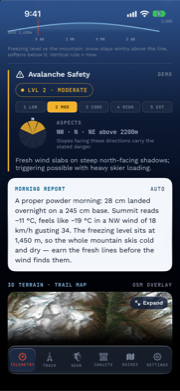
Alpy’s rule for safety features is strict: state measured facts, never give advice, and never let an estimate dress up as a measurement. Two new instruments live under that rule.
The aspect rose
Avalanche bulletins don’t just publish a danger level — the good ones name the aspects: which compass directions of slope carry the problem (“NW–NE above 2200 m” is a classic winter pattern, wind slabs on the shaded side). Alpy already showed the level on the official 1–5 scale; now, when the bulletin names aspects, they’re drawn the way bulletins themselves draw them — a compass rose with the dangerous sectors filled in the danger color.
One honest detail: when a bulletin publishes finer-grained aspects than the eight-point rose (say “NNE”), Alpy ignores that string rather than rounding it to a neighbor. We don’t guess with safety data.
…checked against your actual day
Here’s the part no printed bulletin can do. In the debrief of a tracked day, any run whose measured course fell into the bulletin’s named aspects gets a quiet flag. The footnote states the physics plainly: your descent course stands in for the slope’s aspect (the fall line descends the way the slope faces) — a proxy, not a slope measurement — and pistes are avalanche-controlled, so the flag matters beside and beyond the groomed runs, not on them. The flag also never applies to past days judged against today’s bulletin; that comparison would simply be false.
The last-run light
The second instrument is simpler: while you’re tracking a day, Alpy knows the resort’s forecast sunset. When you’re inside the final 45 minutes of light, a chip appears in the live cockpit — sunset time, minutes remaining — and after sunset it says, plainly, that the light is going. No push notifications, no nagging, no advice about what you should do. A fact, stated at the moment it’s relevant, because the classic end-of-day mistake is not knowing it’s 16:40.
Why so restrained?
Because trust in a safety feature is spent the first time it exaggerates. An app that says “DANGER: turn back!” is guessing about your situation; an app that says “bulletin names NW–NE above 2200 m; your run 4 pointed N” is handing you the bulletin’s own facts, aligned with your own track. The judgment stays where it belongs — with the person on the snow. For how to read the bulletin itself, see how to read an avalanche bulletin.
Both instruments are free in Alpy, like everything else. The bulletin data comes from the official warning services (SLF, avalanche.org); when a region has no bulletin, the app says exactly that instead of inventing one.